Better at Home Victoria
Better at Home Initiative Australia: Who Qualifies & What’s Next
The idea of treating acutely unwell patients in their own homes rather than hospital beds has moved from fringe experiment to mainstream healthcare policy faster than most people expected. In the United States, the Consolidated Appropriations Act, 2026 extended the CMS Acute Hospital Care at Home waiver through to September 2030—as of February 2026, 419 hospitals across 39 states are approved to deliver hospital-level care at home, and a CMS-commissioned study found the program produced lower mortality rates and fewer costs compared to traditional inpatient care [1]. Across the United Kingdom, Canada, and parts of Europe, hospital-at-home models are scaling rapidly. Healthcare systems that once viewed the concept as a niche workaround are now treating it as a core strategy for managing bed pressure, reducing healthcare-acquired infections, and simply giving patients the dignity of recovering in familiar surroundings.
Australia has been part of this global shift, though you would be forgiven for not noticing. The conversation here has been quieter, more incremental, and largely concentrated in one state. The case for it is not hard to make. The AMA’s 2025 Public Hospital Report Card found that public hospital beds available per 1,000 Australians aged over 65 sit at just 14.3—a record low, and less than half the capacity of the early 1990s. Only 55% of ED presentations are completed within four hours, and a third of category-two emergency patients (presenting with conditions like chest pain or acute stroke) are not seen within the recommended 10-minute window [1]. Against that backdrop, treating appropriate patients at home rather than in hospital beds is not just clinically sensible. It is structurally necessary.
Victoria’s Better at Home initiative has been running since 2020, has accumulated more than one million admitted bed days delivered outside of hospital, and in May 2024 was confirmed as a permanent treatment offering—no longer a pilot. The program now delivers over 350,000 admitted bed days each year across 49 HITH sites statewide [2]. Yet many patients, carers, GPs, and allied health professionals across the country have either never heard of it or do not fully understand what it covers, who qualifies, or what happens when it ends.
This post aims to change that. Whether you are a patient who has been referred to a hospital-at-home program, a family member trying to understand what your loved one’s care looks like, a GP navigating referral pathways, or an allied health professional working in the community, here is what you actually need to know.
What Is Victoria’s Better at Home Initiative?
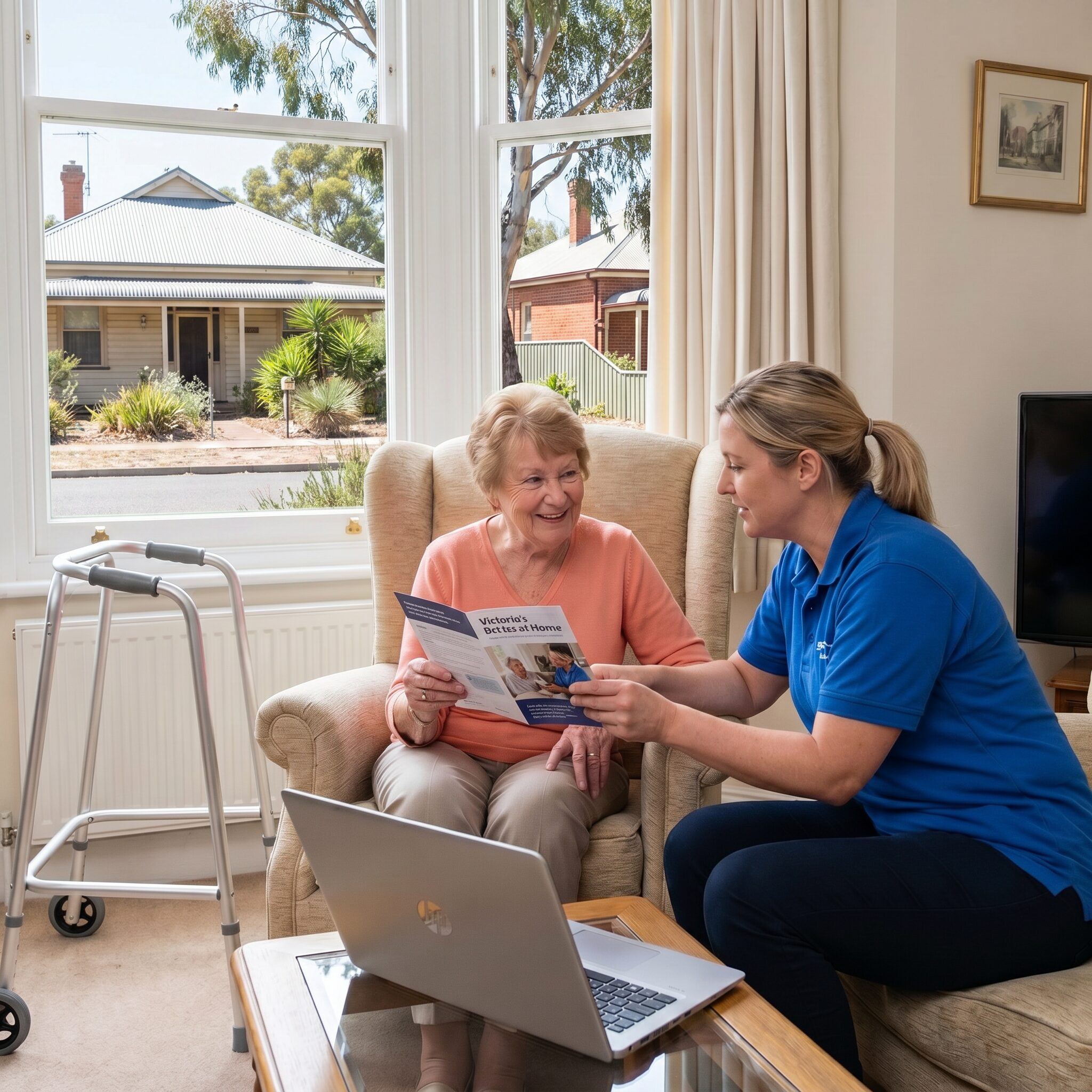
Better at Home is a Victorian Government program that allows eligible patients to receive admitted hospital-level care in their own home rather than an inpatient ward. It is not a step-down service, a community nursing program, or a discharge support arrangement. Patients enrolled in Better at Home are formally admitted to a participating hospital. Their care is managed by hospital clinical teams. The difference is simply that the physical location of that care is the patient’s home rather than a hospital bed.
The program launched in July 2020 as part of Victoria’s response to COVID-19 pressures on the hospital system, but it has evolved well beyond its pandemic origins. Total investment has now reached $819 million to establish and expand the initiative statewide [2]. The clinical conditions treated under Better at Home span a broad range: infections requiring intravenous antibiotics, post-surgical recovery, cancer treatment support, rehabilitation, geriatric evaluation and management, and management of chronic disease exacerbations. Each patient’s eligibility is assessed by the treating clinical team based on clinical stability, home environment, carer availability, and the patient’s own preferences.
Victoria’s investment in home-based acute care extends beyond the core Better at Home program. In December 2025, the state launched its first dedicated Virtual Hospital Pilot—a partnership between Austin Health and the Royal Melbourne Hospital, backed by $3 million from the 2025/26 Victorian Budget [2]. The pilot uses virtual wards, remote monitoring, and specialist telehealth consultations to treat patients who would otherwise require inpatient admission, with an initial focus on cardiac patients and regional access to specialist care. As of April 2026, the pilot has treated more than 260 patients and saved over 1,000 hospital bed days, with plans to expand to 400 patients by June 2026 [2]. The Victorian Virtual Emergency Department separately received $437 million in the 2025/26 Budget to double its capacity and become permanent—a further signal that virtual and home-based care is being treated as mainstream infrastructure, not a workaround.
The model works because it is genuinely hospital-grade. The clinical oversight does not disappear when a patient goes home. Nurses visit daily or more frequently depending on need. Telehealth monitoring is available. If a patient deteriorates, there are clear escalation pathways back to the hospital. A March 2025 perspective published in the Medical Journal of Australia described Hospital in the Home as a “sustainable, patient-centred, value-based solution” to the mismatch of demand and capacity in Australia’s health system, noting that when it substitutes for hospital admission, clinical outcomes and patient satisfaction are comparable or improved, and care is cost-effective [3].
Families tell us that what they value most is not just the convenience but the sense that someone senior and clinically capable is still overseeing their loved one’s care.
Who Qualifies for Better at Home in Victoria?
Eligibility is determined by the treating hospital team, not by the patient or their GP directly. In general terms, patients need to meet several criteria.
Clinically, they must be stable enough to be safely managed outside a hospital ward, but still require admitted-level care. This is a narrow band by design. Too unwell and the hospital environment remains necessary. Stable enough to go home without formal admission, and they would be discharged through a standard pathway rather than enrolled in Better at Home.
From a practical standpoint, the home environment itself is assessed. The home must be safe for clinical staff to visit. Basic utilities need to be in place. There should ideally be a carer or family member present, particularly overnight, though this requirement varies depending on the clinical condition and the health service’s protocols.
The patient’s own consent and willingness to participate matters significantly. Some patients, particularly those who live alone or who feel anxious about receiving clinical care at home, are not suited to the program regardless of their clinical profile.
Referral pathways typically begin in the emergency department or through an inpatient ward when a patient is being assessed for admission or is already admitted and ready for a shift in care setting. GPs can raise the possibility with hospital teams but cannot directly enrol patients.
The Evidence Base for Home-Based Acute Care
The clinical case for hospital-at-home models has strengthened considerably in Australia in the past 12 months. A February 2026 study published in npj Digital Medicine evaluated the Back@Home virtual hospital model across four hospitals in the Sydney Local Health District—the most rigorous recent Australian evidence on the subject. Patients presenting to emergency departments with low back pain who received virtual hospital care had a 41% reduction in emergency department re-presentations within 30 days, and reported significantly less pain and better physical function compared to those receiving usual care [4]. The study covered 18,851 ED presentations from January 2017 to January 2025, making it one of the largest Australian analyses of home-based acute care outcomes.
This sits within a broader evidence base. A 2025 systematic review of HITH services for older Australians found that benefits included efficacy, high patient satisfaction, and effective medical management, with patient outcomes closely aligned with the admission pathway used [5]. Victoria’s own program data shows that Northern Health’s Maternity in the Home and Medical Obstetrics at Home programs contributed to a 50% reduction in hospital readmissions for eligible patients [2].
The Rest of Australia: A Much Patchier Picture
Victoria’s program is the most developed in the country, but other states have their own versions, each with different names, scopes, and levels of resourcing.
New South Wales operates Hospital in the Home (HITH) services through a range of local health districts. In February 2025, NSW Health released a new Hospital in the Home Policy Directive, advocating for a centralised access point to HITH services and replacing a 2017 admission policy that had made no specific reference to HITH at all [3]. This signals growing institutional commitment to the model in NSW, though coverage across regional and rural areas remains uneven and referral pathways vary considerably between health districts.
In Queensland, hospital-in-the-home programs exist within several Hospital and Health Services, but like NSW, there is no single unified statewide program comparable to Victoria’s Better at Home. Access depends heavily on where you live and which health service is responsible for your care.
Western Australia has HITH services operating within its public health system, but the state’s vast geography creates enormous access challenges. For patients in regional and remote areas, the model that works reasonably well in Perth metropolitan areas is often simply unavailable.
South Australia and the smaller states and territories have their own arrangements, varying in scope and maturity.
The honest picture is this: if you are in metropolitan Victoria and you are eligible, you have access to one of the best-developed hospital-at-home programs in the southern hemisphere. If you are in rural Queensland, outer Western Australia, or many parts of regional NSW, your access to equivalent care is significantly more limited, and often non-existent.
What Better at Home Does Not Cover
This is the part that catches families off guard, and it is something we see consistently through the practitioners on our network.
Better at Home is an acute care program. It covers the period of formal hospital admission. When a patient is clinically ready to be discharged, the program ends. At that point, they transition back to their GP and community health system just as they would after any hospital discharge.
The challenge is that clinical readiness for discharge does not mean a patient is fully recovered or fully independent. Someone who has been treated for a serious infection at home, or who has come through a complex post-surgical recovery period, is often still managing fatigue, deconditioning, pain, reduced mobility, and a raft of practical challenges at home. They may need physiotherapy to rebuild strength and function. They may need occupational therapy to assess their home environment and support their return to daily activities. They may need podiatry, speech pathology, dietetics, or psychology depending on what they have been through.
None of that is covered by Better at Home. And while GPs and community health services play an important role in coordinating ongoing care, the reality is that community health waitlists are long, allied health services are not always easy to access quickly, and the patient and their family are often left managing the gap themselves.
This is not a criticism of Better at Home. The program does what it is designed to do, and it does it well. The gap exists not because the program has failed but because acute care and ongoing community-based recovery support are different things, funded differently, delivered by different workforces, and coordinated through different systems.
Where Mobile Allied Health Comes In
For families navigating the post-acute period, the practical question is straightforward: how do we find a qualified practitioner who can come to our home, understand our situation, and provide the follow-up support that recovery actually requires?
This is exactly the problem that Home Visit Network was built to solve. The platform was founded by a mobile therapist who experienced firsthand the frustration that both patients and practitioners face: patients who cannot easily access the community-based care they need, and allied health professionals who want to provide mobile services but lack an efficient way to connect with patients in their area.
A postcode search on Home Visit Network allows patients, carers, and families to find qualified mobile practitioners across a range of disciplines—physiotherapy, occupational therapy, podiatry, speech pathology, dietetics, psychology, and more—who are available to visit homes in their specific area. For someone transitioning out of a Better at Home episode of care, or indeed out of any hospital admission, this can significantly reduce the time between discharge and the start of meaningful allied health support.
Practitioners found through the platform include those experienced in working with post-acute patients, older Australians, people living with disability, and those managing complex chronic conditions. Many are able to work across Medicare-subsidised care plans (including the GP Chronic Condition Management Plan, which replaced the old Management Plan items from 1 July 2025), NDIS funding, DVA arrangements, and private fee structures—which matters enormously given the funding complexity that patients and families often face.
It is worth noting that from March 2025, MBS reforms restricted more than 800 MBS items to hospital settings only, meaning some services previously available in community settings are now only claimable in accredited facilities [3]. This has no direct bearing on the allied health and nursing services that mobile practitioners typically deliver under a GPCCMP or NDIS funding, but it is worth confirming with your referring GP or specialist that any specific items you expect to claim remain available in a home-visit context.
The therapists on our network report that some of their most complex and rewarding work involves patients who have recently transitioned out of a hospital-at-home program. These patients often have layered needs, are managing multiple concerns simultaneously, and genuinely benefit from a practitioner who understands the home environment and can deliver care adapted to the person’s actual living situation rather than a generic clinic setting.
FAQ
What is the Better at Home program in Victoria?
Better at Home is a Victorian Government program that allows eligible patients to receive formal admitted hospital care in their own home. Patients are admitted to a participating hospital and managed by clinical teams, but the care is delivered in their home setting rather than on a ward. The program has delivered over one million admitted bed days since 2020, is now permanent, and delivers more than 350,000 bed days per year across more than 45 health services.
Who is eligible for Better at Home?
Eligibility is determined by the treating hospital clinical team. Patients must be clinically stable enough to be safely managed at home but still require admitted-level care. The home environment is also assessed, and patient consent is essential. Most referrals occur through emergency departments or inpatient wards.
Does Better at Home cover allied health services after discharge?
Better at Home covers acute hospital-level care during the period of formal admission. Once a patient is discharged from the program, ongoing allied health services such as physiotherapy, occupational therapy, and podiatry are not covered. Patients need to arrange these through their GP, community health services, or through a platform like Home Visit Network. Medicare’s GP Chronic Condition Management Plan (GPCCMP) may fund up to five subsidised allied health visits per year for eligible patients.
Is there a Better at Home program in other Australian states?
Other states including NSW, Queensland, and WA have Hospital in the Home services, but these vary significantly in scope, coverage, and accessibility. Victoria’s Better at Home is currently the most developed and consistently delivered statewide program in Australia. NSW Health updated its HITH Policy Directive in February 2025 to strengthen the model’s integration in NSW hospitals.
How do I find a mobile allied health practitioner after a hospital-at-home discharge?
You can use Home Visit Network’s postcode search to find qualified mobile allied health professionals in your area across physiotherapy, occupational therapy, podiatry, speech pathology, psychology, dietetics, and more. Many practitioners work across Medicare, NDIS, DVA, and private funding arrangements.
Can a GP refer a patient to Better at Home?
GPs cannot directly enrol patients in Better at Home but can raise the option with hospital treating teams. The formal assessment and enrolment process is managed by participating hospitals, typically through the emergency department or an inpatient ward.
References
- Centers for Medicare and Medicaid Services. Acute Hospital Care at Home Data Release Fact Sheet. March 2026. Program extended through September 30, 2030 under the Consolidated Appropriations Act, 2026 (P.L. 119-75). cms.gov; American Medical Association. Lawmakers extend CMS hospital-at-home waiver for five years. February 2026. ama-assn.org; Australian Medical Association. 2025 Public Hospital Report Card. February 2025. ama.com.au
- Victorian Department of Health. Better at Home initiative — permanent program. $819 million invested; 1 million+ admitted bed days since July 2020; 350,000+ per year across 49 HITH sites (February 2026). health.vic.gov.au; Victorian Government Premier’s Office. More patients getting better from comfort of home. May 2024; Virtual Hospital Making Care Easier For More Victorians. April 2026. premier.vic.gov.au; Victorian Department of Health. Virtual Hospital Pilot. Commenced 1 December 2025. health.vic.gov.au
- Cubitt M, et al. A future for the hospital-in-the-home (HITH) deteriorating patient: shifting the paradigm. Medical Journal of Australia. 2025;222(4):168–171. doi: 10.5694/mja2.52588; NSW Health. Hospital in the Home Policy Directive. Effective 18 February 2025.
- Sigera C, Oliveira CB, Melman A, et al. Effectiveness of a virtual hospital model of care for patients with low back pain presenting to emergency departments (Back@Home). npj Digital Medicine. 2026;9:191. doi: 10.1038/s41746-026-02425-8
- Bransgrove NJ, Porter JE, Peck B, Bishop J. Barriers, benefits, and enablers of acute home-based care (Hospital in the Home) in Australia for older people: a systematic review. Home Health Care Management and Practice. 2025. doi: 10.1177/10848223241252931