aged care OT assessment
Mobile Occupational Therapy Home Visits in Australia

Something significant shifted in Australian aged care on 1 November 2025. The Support at Home program replaced the old Home Care Packages and CHSP framework, and with it came the Assistive Technology and Home Modifications (AT-HM) scheme. This scheme places occupational therapy assessments right at the centre of how older Australians access funding for equipment and home modifications. Under the scheme, every home modification—and every item classified as “prescribed” on the AT-HM list—requires a prescription from a suitably qualified health professional, typically an occupational therapist [1]. If you want a grab rail fitted, a shower chair prescribed, or a stairlift funded through Support at Home, an OT assessment is not optional. It is the gateway.
At the same time, NDIS participants have long relied on occupational therapists for functional capacity assessments, specialist disability accommodation reports, and assistive technology recommendations. That hasn’t changed. What’s changed is the volume of Australians who now need access to a qualified OT, and the urgency around finding one who can come to them.
That’s exactly where mobile occupational therapy steps in.
What Is a Mobile Occupational Therapy Home Visit?
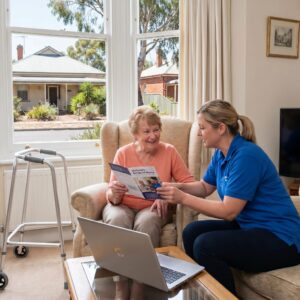
A mobile occupational therapist is a credentialled allied health professional who travels to a patient’s home, aged care residence, or community setting rather than requiring the patient to attend a clinic. The assessment happens in the actual environment where the person lives, moves, cooks, showers, and sleeps.
This isn’t a niche service. For anyone who is housebound, recovering from surgery, living with a progressive neurological condition, or simply struggling to get to appointments, a home visit isn’t a luxury. It’s the only way an accurate assessment can happen.
Home Visit Network was built by a mobile therapist who understood this firsthand. The platform exists because finding a qualified mobile OT in your postcode shouldn’t require making a dozen phone calls and waiting weeks for a callback. The therapists on our network report that demand for home-based OT has increased substantially since the Support at Home reforms were announced, and families who use our platform tell us that connecting with someone quickly, without the administrative burden, makes an enormous difference during what is often a stressful time.
What Does a Mobile OT Actually Do During a Home Visit?
Occupational therapy covers a broad scope of practice. Here’s what a mobile OT will commonly assess and address during a home visit in Australia.
Falls Risk Assessment and Prevention
Falls are the leading cause of injury hospitalisations in Australia, and in 2023–24 alone, fall injuries cost the health system over $5 billion [2]. Among older Australians, 53% of hospitalised falls occur at home—and bathrooms and outdoor areas are the most common specific locations [2]. The Australian Commission on Safety and Quality in Health Care updated its Falls Best Practice Guidelines in 2025—the first revision in sixteen years—with a dedicated community care edition that reinforces environmental assessment as a core component of falls prevention for people living at home [3].
A mobile OT will walk through the home systematically, looking at floor surfaces, lighting, furniture placement, bathroom layout, and outdoor access. They’ll assess the person’s balance, mobility, and confidence in moving through their own space. The recommendations that follow are grounded in what they’ve actually observed. That’s a critical distinction. An OT who has seen the narrow bathroom, the step at the back door, and the loose rug in the hallway can prescribe modifications with precision. An OT relying on a self-reported floor plan cannot.
Bathroom and Kitchen Set-Up
Bathrooms are where independence is most often compromised first. A mobile OT will assess transfers in and out of the shower or bath, toilet access, reaching and bending capacity, and whether current fixtures match the person’s functional abilities.
Kitchen assessments cover meal preparation safety, appliance access, storage height, fatigue management, and whether adaptive equipment such as one-handed cutting boards, jar openers, or angled utensils would help maintain independence.
Equipment Prescription and Assistive Technology Recommendations
Mobile OTs are authorised to prescribe assistive technology across a wide range of categories including mobility aids, shower chairs, commodes, bed rails, transfer belts, and communication devices. Under the Support at Home AT-HM scheme, the scheme classifies every item as low risk, under advice, or prescribed. Prescribed items—which include complex or costly equipment adapted to individual needs—require a prescription from a suitably qualified health professional before funding is approved [1]. All home modifications, regardless of complexity, must also be prescribed by a qualified OT or physiotherapist.
One significant advantage of the AT-HM scheme design: health professional assessments and prescriptions are classified as clinical care under Support at Home, meaning participants pay no out-of-pocket contribution for the OT assessment itself [1].
Getting the prescription right in the home context matters. An OT who trialled a piece of equipment with a patient in their actual bedroom, on their actual floor surface, will write a more accurate and defensible prescription than one working from a clinical assessment alone.
Cognitive and Daily Living Assessments
For people living with dementia, acquired brain injury, stroke, or other conditions affecting cognition, mobile OTs conduct standardised assessments of daily living function. These might include the Assessment of Living Skills and Resources (ALSAR), the Functional Independence Measure (FIM), or cognitive screening tools such as the Montreal Cognitive Assessment (MoCA).
These assessments inform care planning, NDIS functional capacity reports, and recommendations for supported living or home-based support hours. Conducting them in the home, where the person is most comfortable and where their daily routines are visible, typically produces more accurate results than a clinical setting.
Post-Discharge Rehabilitation
When someone returns home after a hip replacement, stroke, cardiac event, or major surgery, the transition is often where things go wrong. A mobile OT can be involved from day one after discharge, assessing the home environment before the patient even arrives back, arranging equipment loan or purchase, and then supporting rehabilitation in the actual space where recovery needs to happen.
Families who use our platform tell us that having an OT come to the home in the first week after discharge is one of the most practical things they’ve arranged. It removes the enormous burden of trying to transport a recently discharged person to clinic appointments while managing pain, fatigue, and anxiety.
Why Being Assessed at Home Produces Better Recommendations
Clinic-based assessments are valuable for many things. But when the goal is to understand how someone functions in their specific home environment, the clinic is the wrong setting. People perform differently in unfamiliar environments. They may use different movement strategies. They can’t demonstrate how they navigate their own kitchen because they’re not in it.
A mobile OT sees the actual grab rail that’s been installed at the wrong height. They see the carpet that creates a trip hazard. They see that the bedroom is accessed by a narrow hallway that won’t fit a standard walking frame. None of that is visible from a clinic.
The ACSQHC’s updated 2025 Falls Guidelines for community care reinforce this: environmental assessment by a qualified health professional, conducted in the person’s actual living environment, is the evidence-based standard for falls prevention in people living at home [3]. You can’t assess the environment without being in it.
For NDIS participants, this translates directly into the quality of functional capacity assessments and SDA eligibility reports. The NDIA expects OT reports to reflect a thorough understanding of the participant’s lived environment and functional capacity within it. A home visit assessment delivers that in a way a clinic visit cannot.
Who Pays for a Mobile Occupational Therapy Home Visit?
Funding for mobile OT in Australia comes from several sources depending on the person’s circumstances.
Support at Home — AT-HM Scheme (from November 2025)
One of the most important features of the new AT-HM scheme is that its funding is separate from a participant’s quarterly Support at Home care budget. This means older Australians do not have to save up from their regular care allocation to access equipment or home modifications—the two streams are independent [1]. AT-HM funding is available for a 12-month period (extendable under some circumstances).
Access to Support at Home begins with an aged care assessment using the Integrated Assessment Tool (IAT), which replaced the previous ACAT model from 1 November 2025. Participants register via My Aged Care and receive a Notice of Decision and Support Plan. The program uses eight ongoing classification levels (up from the four previous HCP levels), with maximum annual funding rising to $78,106. Where an OT assessment is available ahead of the IAT, it can strengthen classification outcomes by providing evidence of functional need [1].
It is worth noting that the IAT has attracted significant scrutiny since its rollout. By late March 2026, over 834 review requests had been lodged—more than double the number received in the program’s first weeks—prompting a Senate inquiry in April 2026 and a Commonwealth Ombudsman investigation [1]. A key concern raised at Senate estimates is that assessment delegates are prohibited from overriding the algorithm’s classification, and that qualitative clinical notes entered by assessors are not fed into the funding decision. For older Australians and their families, this underscores the value of having a formal, documented OT assessment on file before or alongside the IAT process—evidence that is structured to align with how the tool processes clinical data.
OT assessments and prescriptions under the AT-HM scheme are classified as clinical care—there is no participant contribution for the assessment itself. For prescribed items costing over $15,000, a pre-approval process is required, supported by the OT’s prescription and quotes lodged via the My Aged Care Service and Support Portal [1].
One important near-term development: the Australian Government’s mandatory price caps for all Support at Home services, including occupational therapy, are scheduled to take effect from 1 July 2026, set by the Independent Hospital and Aged Care Pricing Authority (IHACPA). Until then, providers set their own prices—the current national median indicative price for OT is approximately $200 per hour face-to-face. Occupational Therapy Australia has raised concerns that the indicative price range does not fully reflect OT costs including travel and report writing [1].
OT services can also be accessed through allied health service budgets under Support at Home where included in a participant’s support plan. In a further expansion announced in April 2026, the Australian Government reclassified showering, dressing, and continence management as clinical care under Support at Home, backed by an additional $1 billion investment [1]. This means personal care tasks that previously competed with OT and allied health for budget allocation are now separately funded—reducing the trade-offs older Australians previously faced between clinical and personal care. Occupational Therapy Australia welcomed the announcement as a meaningful improvement to how care is prioritised and funded in the home. If you’re navigating this for an older family member, speak to their Support at Home provider or contact My Aged Care on 1800 200 422.
NDIS
NDIS participants can access OT funding under Capacity Building supports—specifically within the Improved Daily Living category (CB Daily Activity). From 1 July 2025, all therapy supports including occupational therapy must be funded from the Capacity Building budget; the previous flexibility to draw on Core supports for therapy no longer applies [4]. Funding can cover functional capacity assessments, assistive technology assessments and prescriptions, home modification reports, and ongoing therapeutic support. A support coordinator or plan manager can help confirm what’s available in a participant’s current plan.
A significant reform was announced in April 2026: from 1 February 2027, diagnosis-based access to the NDIS will be replaced by standardised functional capacity assessments for new entrants and plan renewals. This will directly affect OTs, who may be called upon more frequently to conduct the assessments that determine NDIS eligibility and support levels. Occupational Therapy Australia has raised concerns about how these assessments will be structured and is seeking further detail from the NDIA [4].
Medicare — GP Chronic Condition Management Plan (GPCCMP)
From 1 July 2025, the previous GP Management Plan and Team Care Arrangement items were replaced by the GP Chronic Condition Management Plan (GPCCMP), which provides up to five Medicare-subsidised allied health visits per calendar year for people with a chronic or complex condition. The current rebate is $61.80 per session. Post-discharge OT needs may qualify depending on clinical circumstances—speak with your GP about whether a GPCCMP referral letter is appropriate.
DVA (Department of Veterans’ Affairs)
Eligible veterans and war widows/widowers can access OT services through DVA’s Community Nursing and Allied Health programs. The DVA Gold Card covers a wide range of allied health services including occupational therapy. Referral is typically through a GP or treating specialist. The therapists on our network who work with DVA clients report that home visits are regularly approved and well-supported through this pathway.
Commonwealth Home Support Programme (CHSP)
The CHSP has been extended until 30 June 2027 before transitioning into Support at Home. From 1 November 2025, all CHSP clients—including those previously receiving services without a formal assessment—must be assessed for aged care eligibility via My Aged Care to continue receiving government-subsidised services, including OT. If you or a family member has been receiving CHSP-funded OT without a recent assessment, contact My Aged Care to ensure eligibility is confirmed before services are disrupted [4].
Private Health Insurance
Many Australians with extras cover can claim occupational therapy home visits through their private health insurer. Benefit amounts and annual limits vary significantly between funds. Check your policy details or contact your fund directly to confirm whether mobile or home-based OT is covered and what gap payments apply.
Self-Funded
For those without applicable funding, mobile OT home visits are available on a private, self-funded basis. Costs vary depending on the therapist’s experience, location, and assessment complexity. Many providers offer an initial consultation to discuss the scope of work before formal assessment begins.
The Carer and Family Dimension
It would be a disservice to write about mobile occupational therapy without acknowledging the people who are often coordinating all of this: carers and family members.
If you’re the adult child who has noticed your parent isn’t managing at home the way they used to, or the partner who is exhausted from helping with showering and dressing every morning, or the sibling who lives interstate and is worried sick about what’s happening at home, a mobile OT visit is often one of the most concrete steps you can take.
A good OT doesn’t just assess the patient. They speak with the family. They explain what they’re observing and why. They provide written recommendations that can be shared with GPs, case managers, and funding bodies. They sometimes identify risks that the person themselves has minimised or normalised.
Families who use our platform tell us that one of the most valuable parts of the visit is simply having a qualified professional look at the situation and say: here’s what I’m seeing, here’s what would help, and here’s how we access it. That clarity is genuinely valuable when you’re managing care from a distance, or while holding down a job and raising your own family.
Frequently Asked Questions
How do I find a mobile occupational therapist who covers my area?
Use the postcode search on Home Visit Network to find qualified mobile OTs registered in your area. The platform was built specifically to connect Australians with mobile allied health practitioners, and therapists on the network indicate the geographic areas they cover.
Do I need a GP referral to see a mobile OT?
In most cases, no. You can self-refer to an occupational therapist in Australia. However, certain funding pathways require a referral: Medicare-subsidised visits under the GP Chronic Condition Management Plan (GPCCMP) require a referral letter from your GP, and some DVA programs have their own referral requirements. Check with your funding body if you’re unsure.
How long does a mobile OT home visit take?
An initial assessment visit typically takes between 60 and 90 minutes, depending on the complexity of the person’s needs and the size of the home. Follow-up visits for equipment trials or progress reviews are often shorter.
Can a mobile OT write reports for NDIS or Support at Home funding applications?
Yes. Qualified OTs can write functional capacity assessments, assistive technology prescriptions, home modification reports, and SDA eligibility reports that meet NDIS requirements. For Support at Home, OTs can provide the assessments and prescriptions required under the AT-HM scheme. The OT assessment itself is classified as clinical care under Support at Home, so participants pay no out-of-pocket contribution for it.
What should I do to prepare for a mobile OT home visit?
Have a list of your current medications available, as these can affect balance and cognition. Think about the specific tasks or areas of the home where you’re struggling. If a family member or carer is going to be present, plan for them to be there if possible. There’s no need to tidy or rearrange the home before the visit. The OT needs to see the space as it normally is.
Is mobile OT available in regional and rural areas?
Yes, though availability varies. Home Visit Network includes practitioners across metropolitan, regional, and rural areas. Telehealth components can sometimes supplement in-person visits for those in very remote locations, though a physical home visit is required for environment assessments.
Finding a Mobile OT Near You
If you or someone you care for needs a mobile occupational therapy home visit, the most direct next step is to search by postcode on Home Visit Network. The platform connects you with qualified mobile OTs who are actively taking referrals in your area, without the wait and without the phone tag.
Whether you’re navigating the new Support at Home reforms, working through an NDIS plan, supporting a veteran, or simply trying to help someone you love stay safely in their own home for longer, a mobile OT home visit is often where practical progress begins.
Search for qualified mobile OTs in your area at Home Visit Network.
References
- Australian Government Department of Health, Disability and Ageing. Assistive Technology and Home Modifications (AT-HM) Scheme. Support at Home Program, effective 1 November 2025. AT-HM Scheme Guidelines, October 2025. health.gov.au; My Aged Care. Assistive Technology and Home Modifications scheme. myagedcare.gov.au; Occupational Therapy Australia. Support at Home OT FAQ and Spotlight on Aged Care advocacy. November 2025; OT price caps from 1 July 2026 (IHACPA); current national median indicative OT rate $200/hour. otaus.com.au; Australian Ageing Agenda / The Conversation / Medical Republic. IAT algorithm controversy: 834 review requests by 30 March 2026; Senate inquiry April 2026; Commonwealth Ombudsman investigation launched. April 2026; Australian Government. Personal care reclassified as clinical care, $1 billion investment announced. April 2026.
- Australian Institute of Health and Welfare. Falls. Updated 2025, covering 2023–24 data. aihw.gov.au; Australian Institute of Health and Welfare. Falls in older Australians 2019–20: hospitalisations and deaths among people aged 65 and over. AIHW, 2022. aihw.gov.au
- Australian Commission on Safety and Quality in Health Care. Preventing Falls and Harm from Falls in Older People: Best Practice Guidelines for Community Care. ACSQHC, Sydney, 2025. First revision since 2009. safetyandquality.gov.au
- National Disability Insurance Agency. NDIS Pricing Arrangements and Price Limits 2025–26, effective 1 July 2025. Allied health therapy supports funded exclusively from Capacity Building from 1 July 2025. ndis.gov.au; Occupational Therapy Australia. Statement on NDIS access reform — diagnosis-based access to be replaced by functional capacity assessments from 1 February 2027. April 2026. otaus.com.au; Department of Health, Disability and Ageing. GP Chronic Condition Management Plan (GPCCMP), effective 1 July 2025; Commonwealth Home Support Programme extension to 30 June 2027 — mandatory assessment requirements from 1 November 2025. health.gov.au