aged care speech pathology
Swallowing Difficulties in Older Adults: Signs & Help
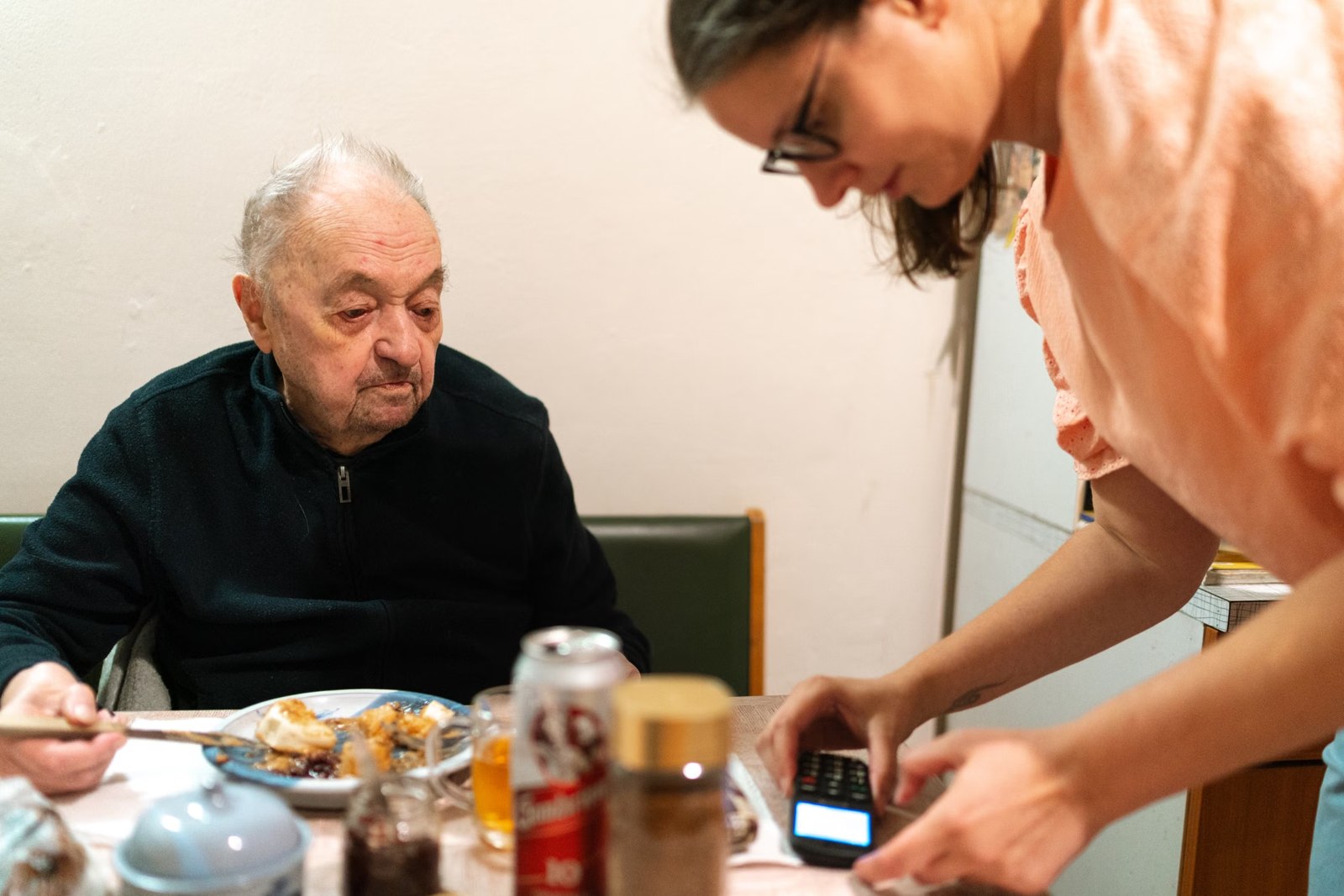
When an older person starts coughing at the dinner table, takes longer to finish meals, or quietly starts refusing foods they once enjoyed, families often chalk it up to ageing. “Mum’s just eating more slowly.” “Dad never liked chicken anyway.” What they may be missing is a clinical sign that warrants prompt assessment: dysphagia, or swallowing difficulty.
This is far more common than most families realise. Dysphagia affects an estimated 15 to 22 per cent of community-dwelling adults over the age of 50, and prevalence rises sharply in residential aged care, where a 2024 systematic review and meta-analysis found more than half of residents are affected.[1] Among residents living with dementia, one study put the figure as high as 68 per cent.[1]
This isn’t a minor quality-of-life inconvenience. Dysphagia in older adults is associated with aspiration pneumonia, malnutrition, dehydration, hospitalisation and reduced survival, and roughly one third of people with dysphagia go on to develop pneumonia.[2] It is also, critically, a condition that responds well to skilled speech pathology intervention, particularly when identified early. The problem is that the symptoms are being missed, minimised or simply absorbed into an accepted narrative of “getting old.”
This article is written for families, carers, GPs and care coordinators who are watching older adults struggle at mealtimes and wondering whether to act. The short answer is: yes, and sooner than you think.
What Swallowing Difficulty Actually Looks Like at Home
The clinical presentation of dysphagia varies widely, and many of the most common signs are easy to rationalise away. Families on our platform regularly describe a slow accumulation of changes rather than a single dramatic event.
Practical warning signs that are commonly normalised include:
- Coughing or throat-clearing during or just after eating or drinking
- A wet or gurgly voice quality after swallowing
- Taking noticeably longer to finish meals, sometimes leaving food on the plate
- Avoiding certain textures, particularly meats, bread or raw vegetables
- Complaining that food “sticks” in the throat or chest
- Recurrent chest infections or a diagnosis of aspiration pneumonia
- Unintentional weight loss or signs of dehydration
- Drooling or difficulty managing saliva
- Reluctance to eat socially or at family gatherings
The behavioural adaptations are what mislead families most. An older person who has quietly shifted to soft foods, eats only small amounts or drinks thickened liquids without being asked is often managing an underlying swallowing problem they may not know how to name, or may feel embarrassed to raise.
An important clinical caution: the absence of coughing does not mean the absence of risk. Silent aspiration, where food or fluid enters the airway without triggering a cough, is common in older adults and is one reason dysphagia goes undetected until a chest infection appears.[2] This is precisely why observation-based screening by a speech pathologist matters rather than waiting for obvious symptoms.
Dementia adds another layer of complexity. Dementia is now Australia’s leading cause of death, with heart disease second. Swallowing deterioration is a common and distressing feature of advanced dementia, but it can also appear in early-to-mid stages and is frequently attributed to “the dementia” rather than being assessed and managed in its own right.
Why Families Normalise It: The Systemic and Social Reasons
There are structural reasons why dysphagia gets missed in the community, not just social ones.
First, swallowing is not routinely screened in aged care or community settings unless the person presents with an acute event like aspiration pneumonia or a hospital admission following a stroke. By that point, the problem has often been developing for months or years. Researchers examining prevalence in residential aged care have argued for routine screening on admission and at regular intervals, irrespective of whether obvious signs are present.[1]
Second, the default GP consultation rarely includes a mealtime observation or swallowing screen unless the clinician is specifically prompted. A standard GP appointment of 10 to 15 minutes does not naturally lend itself to catching subtle functional decline, even with the expanded bulk-billing incentives that took effect on 1 November 2025.[3]
Third, older adults themselves are often reluctant to raise it. There is genuine fear that acknowledging swallowing problems will trigger a conversation about artificial nutrition, tube feeding or residential care. Some worry that eating difficulties will be used as evidence they can no longer manage at home.
Fourth, for people relying on community-based care, there is a lingering assumption that allied health is expensive or hard to access. As we detail below, that assumption is now significantly out of date.
What the Current Healthcare System Offers, and What It Still Gets Wrong
Speech Pathology Under the GP Chronic Condition Management Plan
Since 1 July 2025, the former GP Management Plan and Team Care Arrangement have been replaced by the GP Chronic Condition Management Plan (GPCCMP). Under this structure, a GP can refer a patient with a chronic condition, including dysphagia associated with stroke, dementia, Parkinson’s disease or head and neck cancer, for up to five allied health sessions per year. The referral is via a standard letter rather than a structured form, the rebate is approximately $61.80 per session, and the referral remains valid for 18 months.
Speech pathologists are eligible providers under the GPCCMP. For older adults with dysphagia in the community, this is often the first funded pathway to formal assessment and management.
The limitation is that five sessions per year is frequently insufficient for complex dysphagia, particularly where progressive neurological conditions are involved. A further limitation is that dysphagia currently falls outside the nominated chronic conditions list for MBS allied health items, meaning some community-dwelling older adults with dysphagia may not qualify for GPCCMP referral if their GP determines the condition does not meet the eligibility criteria; Speech Pathology Australia flagged this gap in its October 2025 submission to the MBS allied health reform process. Families should be aware that additional sessions may require private payment or alternative funding pathways, and for eligible older Australians, Support at Home is usually the more sustainable option.
Support at Home: Zero Co-Contribution for Clinical Care
For Australians receiving aged care support at home under the Support at Home program, which replaced the former Home Care Package system on 1 November 2025, the funding picture for dysphagia management has improved substantially.
Speech pathology is classified as clinical care under Support at Home, and clinical care carries zero participant co-contribution. This means that a care partner or case manager can arrange speech pathology swallowing assessments and management, including mealtime advice and texture modification guidance, without the older person contributing financially, regardless of their income or assets.[4]
This is a significant but poorly understood change. Families who were budgeting for allied health from a finite home care budget under the old system may not realise that clinical care is now fully government funded. If a loved one has been going without speech pathology input because of cost concerns under the former system, it is worth contacting My Aged Care on 1800 200 422 to clarify current entitlements.
From 1 October 2026, the Australian Government has announced that certain personal care services, including showering and continence supports, are scheduled to become fully funded under Support at Home, which would further reduce financial barriers for older adults receiving care at home. Confirm the current status of this change with My Aged Care before relying on it.
The Strengthened Aged Care Quality Standards
From 1 November 2025, providers delivering aged care services, including home care under Support at Home and residential aged care, are legally required under Standard 5 of the Strengthened Aged Care Quality Standards to have systematic processes to identify, assess, manage and review pain.[5] Standard 5 also requires providers to have systems for recognising and responding to clinical deterioration more broadly, so failure to identify and act on swallowing difficulties is a governance and compliance issue, not just a clinical one.
For families with a loved one in residential care, this provides a framework for raising concerns formally. If you believe a resident’s swallowing difficulties have not been assessed or managed, you can raise this with the provider and, if unresolved, with the Aged Care Quality and Safety Commission.
Hospital Transitions and the Window Families Often Miss
Many older adults are first identified as having dysphagia during a hospital admission, often following a stroke, pneumonia or aspiration event. The hospital speech pathology team may assess and stabilise the person, but what happens at discharge is where the system frequently fails.
The Transition Care Program, restructured under the Aged Care Act 2024 from 1 November 2025, offers up to 12 weeks of support following a hospital admission. Home-based care under this program usually commences within 48 hours of discharge. For someone with newly identified or worsening dysphagia, this transition window is critical for establishing ongoing speech pathology follow-up in the community.
The Restorative Care Pathway, available through Support at Home for reablement following a functional decline, provides a separate budget of around $6,000, which can extend to approximately $12,000 for eligible participants, for up to 16 weeks. Allied health under this pathway is classified as clinical care and incurs no co-contribution. For a person whose swallowing has deteriorated following an illness or hospitalisation, this pathway can fund the intensive input needed to regain safer swallowing function.
The practical problem is that families are rarely told about these pathways at discharge. Hospital social workers and discharge planners are managing high volumes under ongoing system pressure, and the coordination gap between hospital discharge and community follow-up remains a known weakness of the system. Asking about both pathways explicitly, before discharge, is the most reliable way to access them.
Telehealth for Swallowing: Useful but With Important Limits
Since 2020, telehealth has expanded the reach of speech pathology services, particularly in regional and rural areas where mobile practitioners may be sparse. Telehealth can support review consultations, carer education and monitoring between face-to-face visits.
However, there are important limitations for dysphagia specifically. A full clinical swallowing assessment, and certainly instrumental assessments such as videofluoroscopy, cannot be conducted remotely. Telehealth is a supplement, not a substitute, for in-person assessment when swallowing function is genuinely at risk.
Families and GPs should also note that from 1 November 2025, Medicare telehealth rebates require an in-person GP visit within the previous 12 months, or enrolment in MyMedicare at the patient’s regular practice.[3] If your family member has not seen their GP in person recently, this should be addressed before arranging telehealth-based care.
Digital infrastructure changes may help with continuity. From 2026, pathology and imaging providers are being brought into a requirement to upload results automatically to My Health Record,[6] which will assist in tracking the broader clinical picture for someone with complex swallowing needs, for example identifying nutritional markers or evidence of recurrent chest infections.
Getting an Assessment: The Practical Pathway
For a family concerned about swallowing in an older relative, the pathway looks like this:
- Raise it with the GP at the next appointment, framed specifically as a swallowing concern rather than a vague change in appetite. Describe what you have observed at mealtimes, including timing, textures avoided and any coughing. A GP can initiate a GPCCMP referral to a speech pathologist or arrange a referral to hospital-based speech pathology if the situation is acute.
- For aged care recipients, contact My Aged Care on 1800 200 422 to confirm that clinical care including speech pathology is available under current Support at Home arrangements without co-contribution, and to ensure the person’s care plan reflects the new clinical need.
- For those post-hospital, ask the treating team about the Transition Care Program and whether the Restorative Care Pathway under Support at Home is appropriate.
- Request a mobile speech pathologist if the person cannot attend a clinic. Mobile speech pathologists can conduct clinical swallowing assessments in the home, observe actual meal conditions, advise on texture modification for food prepared at home, and liaise with carers and family members present during the visit. Families and care coordinators can find qualified mobile practitioners by conducting a postcode search on the Home Visit Network platform.
Carers who are supporting someone with dysphagia and feeling the weight of that responsibility can contact Carer Gateway on 1800 422 737 for practical assistance and support services.
The Risk of Waiting
Aspiration pneumonia, meaning lung infection caused by food, liquid or saliva entering the airway rather than the oesophagus, is one of the most preventable causes of hospitalisation and death in older adults with swallowing difficulties. Around one third of people with dysphagia develop pneumonia,[2] and people with dysphagia are readmitted to hospital for pneumonia at nearly twice the rate of those without swallowing problems.[2] The tragedy is not the complication itself but the fact that the warning signs were present for months before it occurred.
Workforce shortages in speech pathology remain a real constraint, particularly in regional areas. This makes early identification and referral more important, not less: waiting until the situation is critical means waiting longer for a service that is already stretched.
The therapists on our network report consistently that family members say, in hindsight, that they noticed changes six months or a year before the acute event. They didn’t act because they didn’t know it mattered.
It does.
Frequently Asked Questions
Is coughing during meals normal for older people?
Occasional coughing can occur for many reasons, but persistent or regular coughing during or after eating or drinking is a clinical sign that warrants a swallowing assessment. It should not be assumed to be a normal part of ageing. Equally, the absence of coughing does not rule out a problem, because silent aspiration can occur without any visible cough response.
Can swallowing difficulties be improved with therapy?
Yes, in many cases. Speech pathologists can assess the nature and severity of the swallowing problem and provide targeted exercises, positioning strategies and dietary modifications. The degree of recovery depends on the underlying cause, but intervention nearly always improves safety and quality of life.
Does Medicare cover speech pathology for swallowing?
A GP can refer to a speech pathologist under the GPCCMP for up to five Medicare-rebated sessions per year (rebate approximately $61.80 per session). For people receiving aged care support at home through Support at Home, speech pathology is clinical care with zero participant co-contribution.
Can a speech pathologist visit at home?
Yes. Mobile speech pathologists can assess and manage swallowing difficulties in the home environment, which has significant advantages: they can observe real mealtimes, assess the actual food and fluids the person is consuming, and involve carers and family members directly in the process.
What if my family member is in residential aged care?
Speech pathology should be available as part of clinical care in residential aged care. Under the Strengthened Aged Care Quality Standards, providers are required to have systematic clinical care processes, including recognising and responding to clinical deterioration. Raise concerns directly with the provider and, if unresolved, with the Aged Care Quality and Safety Commission.
How do I find a mobile speech pathologist?
Home Visit Network connects Australians with qualified mobile healthcare professionals, including speech pathologists, who conduct assessments and therapy in the home. Families can search by postcode. A GP referral is recommended to access Medicare rebates.
References
- Fusco M et al. The Prevalence of Dysphagia in Individuals Living in Residential Aged Care Facilities: A Systematic Review and Meta-Analysis. Healthcare (MDPI), 2024. See also ASHA Practice Portal, Adult Dysphagia (15–22% prevalence in community-dwelling adults over 50).
- Sanivarapu RR, Gibson JG. Aspiration Pneumonia. StatPearls / NCBI Bookshelf (silent aspiration; readmission rates for people with dysphagia). See also ASHA, Adult Dysphagia (approximately one third of people with dysphagia develop pneumonia).
- Australian Medical Association. Changes to Bulk Billing Incentives in General Practice (effective 1 November 2025). Telehealth eligibility requirements from 1 November 2025 per Department of Health.
- Australian Government Department of Health, Disability and Ageing. Support at Home Program (clinical care fully funded with no participant co-contribution). Commenced 1 November 2025.
- Aged Care Quality and Safety Commission. Safety of Clinical Care Services, Strengthened Quality Standard 5, effective 1 November 2025.
- Australian Government Department of Health, Disability and Ageing. Modernising My Health Record (pathology and imaging upload requirements from 2026).